

How to Classify Gig Workers Without Getting Sued by the Department of Labor
The Department of Labor recovered over $322 million in back wages for misclassified workers in 2023 alone. For entrepreneurs building businesses with...
9 min read
Sales commissions drive revenue growth, but poorly structured compensation plans can destroy your business faster than failed marketing campaigns. When commission disputes arise, they don't just cost money—they devastate team morale, trigger expensive legal battles, and can force successful companies into bankruptcy proceedings.

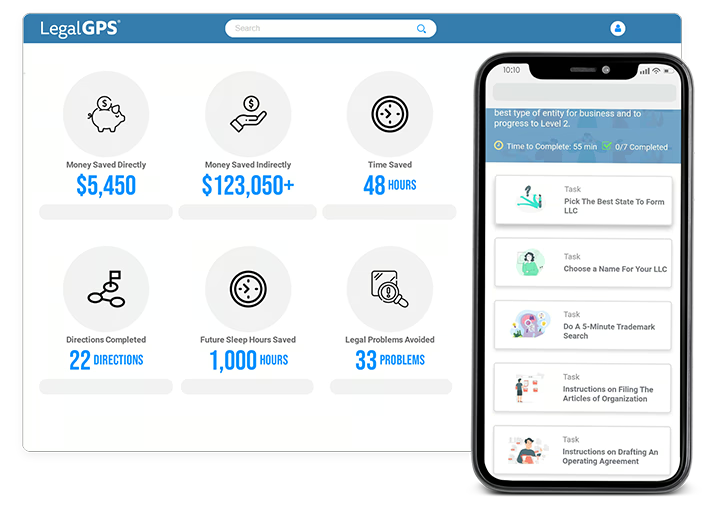
Legal GPS Pro
Protect your business with our complete legal subscription service, designed by top startup attorneys.
Commission conflicts consume resources at multiple levels within your organization. Legal fees for dispute resolution typically range from $15,000 to $75,000 per case, depending on complexity and duration. However, the indirect costs prove far more damaging to long-term business health.
Disputed commissions create immediate cash flow problems when sales teams withhold effort pending resolution. Lost productivity during conflict periods can reduce quarterly revenue by 20-40% in sales-dependent businesses. Team turnover accelerates as top performers seek stable compensation elsewhere, taking institutional knowledge and client relationships with them.
Marcus Thompson built TechStart's software platform with a simple commission structure: 8% of all closed deals. The plan worked perfectly until his company landed enterprise clients requiring 18-month sales cycles involving multiple team members. When Sarah Chen closed a $2.1 million contract after collaborating with three colleagues, the commission dispute exploded into chaos.
Sarah claimed the full $168,000 commission based on her role as primary account manager. Her colleagues demanded portions reflecting their technical presentations and proposal development. Without clear attribution rules, TechStart faced four competing commission claims totaling $340,000—more than the actual commission owed.
The legal battle lasted eight months, costing $47,000 in attorney fees while Sarah and two other top performers left for competitors. TechStart's Q3 and Q4 revenue dropped 45% as the remaining team lost confidence in the compensation system. Marcus eventually settled all claims for $190,000, nearly double the original commission amount.
Commission disputes typically emerge from ambiguous plan language rather than intentional deception. Most entrepreneurs design compensation structures during high-growth periods, focusing on motivation rather than precise legal definitions. This approach creates dangerous gaps that become expensive problems as deals become more complex.
Attribution disputes represent the most frequent source of commission conflicts. When multiple team members contribute to deals, unclear ownership rules create competing claims that can exceed original commission amounts. Territory conflicts arise when geographic or industry boundaries shift without corresponding compensation adjustments.
Timing disputes occur when commission plans fail to address long sales cycles, recurring revenue recognition, or customer payment delays. Modification conflicts emerge when businesses change commission structures mid-cycle without grandfathering existing deals or providing adequate transition periods.
Rate calculation errors stem from poorly defined commission bases, unclear deduction policies, or inconsistent application of bonus multipliers. These mathematical disputes often involve complex spreadsheet reconciliations that strain both legal and accounting resources.
Commission Agreement recording structure, payment schedules, and performance requirements.
Trusted by 1,000+ businesses to safeguard their LLCs.
Most commission disputes trace back to five fundamental design flaws in compensation structures. Ambiguous language allows multiple interpretations of key terms like "closed deal," "qualified lead," or "territory assignment." Missing scenarios fail to address edge cases like cancelled contracts, refunded payments, or transferred accounts.
Conflicting metrics create situations where sales activities satisfy some compensation criteria while violating others. Inadequate documentation prevents verification of commission calculations, leading to disputes over historical payments and future entitlements.
Poor communication during implementation means team members operate under different assumptions about plan mechanics, creating inevitable conflicts when edge cases arise.
Create comprehensive commission calculation worksheets that show exactly how each payment was determined. Include deal attribution matrices, territory assignments, and timing documentation for every transaction. Maintain detailed records of plan modifications, grandfather clauses, and transition communications.
Store all commission-related documentation in centralized systems accessible to relevant team members. Regular audits of commission calculations help identify discrepancies before they escalate into formal disputes. Clear documentation protects your business during legal challenges while demonstrating good faith efforts to maintain fair compensation practices.
Effective commission structures balance motivation with predictability, providing clear guidance for every possible scenario your sales team might encounter. The strongest plans define terms precisely, establish transparent calculation methods, and include dispute resolution mechanisms that prevent legal escalation.
Start with crystal-clear definitions for all commission triggers, including deal closure criteria, payment timing requirements, and territory boundaries. Specify exactly what constitutes a "qualified lead," "closed deal," and "commission-eligible transaction" using measurable criteria rather than subjective judgment.
Establish attribution rules that address team selling scenarios, lead handoffs, and collaborative deal development. Define commission rates clearly, including base percentages, bonus thresholds, and accelerators for exceeding quotas. Include timing provisions that specify when commissions are earned, calculated, and paid.
Address modification procedures that explain how commission plans can change, including advance notice requirements and protection for existing pipeline deals. Include dispute resolution mechanisms that provide structured processes for addressing calculation errors or interpretation disagreements.
Jennifer Walsh transformed MedDevice Solutions' commission structure after inheriting a business plagued by monthly payment disputes. Her previous plan used vague language like "substantial contribution" to determine team selling commissions, creating arguments over every collaborative deal.
Jennifer's new framework established precise attribution percentages: lead generators earned 25%, technical specialists received 20%, and account managers collected 55% of commissions on team deals. The plan defined "substantial contribution" as documented client interactions exceeding two hours, removing subjective judgment from commission calculations.
The framework included automatic dispute resolution through structured review processes. When attribution questions arose, documented client interaction logs determined commission splits according to predetermined formulas. Clear escalation procedures provided appeal mechanisms without requiring legal intervention.
Six months after implementation, MedDevice Solutions eliminated commission disputes entirely while maintaining team collaboration incentives. Sales productivity increased 30% as team members focused on revenue generation rather than compensation arguments. Jennifer's structured approach created predictable costs while preserving motivation for collaborative selling.
Design commission structures that encourage desired behaviors without creating unsustainable payment obligations. Set commission caps or graduated rate reductions for exceptional performance periods to prevent single deals from creating cash flow problems. Include clawback provisions for cancelled contracts or refunded payments.
Consider commission draw programs that provide steady income while maintaining performance incentives. Structure bonuses around achievable metrics that align with business objectives rather than purely revenue-based calculations. Regular plan reviews help identify needed adjustments before they become urgent problems.
Commission structures must comply with complex employment and wage laws that vary significantly between states. Federal regulations establish minimum standards while state laws often provide additional protections for commissioned employees. Understanding these legal requirements prevents costly compliance violations while protecting your compensation structure design.
Some states classify commissioned salespeople as employees entitled to overtime pay, meal breaks, and other standard employment protections. California requires written commission agreements that specify calculation methods and payment timing. New York mandates specific notice periods before commission plan modifications take effect.
Several states require commission payments within specified timeframes after deals close, regardless of customer payment status. Others mandate that earned commissions continue through employment termination, creating ongoing payment obligations for former employees. Failure to comply with state-specific requirements can trigger penalty payments and legal liability.
Research your state's specific requirements for commission agreements, payment timing, and modification procedures. Consider multi-state compliance if your sales team operates across state lines or if team members relocate during employment.
The Fair Labor Standards Act affects commissioned employees' overtime eligibility and minimum wage requirements. Department of Labor regulations specify record-keeping requirements for commission calculations and payment documentation. Equal Employment Opportunity Commission guidelines address discrimination in commission plan design and implementation.
Securities regulations may apply if commission structures include equity components or profit-sharing elements. Tax regulations affect commission payment timing and withholding requirements. International sales operations may trigger additional compliance requirements under export control or anti-corruption laws.
David Kim discovered commission structure compliance requirements the expensive way when RetailFlow faced a Department of Labor audit. His commission plan seemed straightforward: 6% on all sales with monthly payments based on collected revenue. The structure motivated his team effectively until regulators identified multiple compliance violations.
California's labor laws required written commission agreements specifying exact calculation methods, which RetailFlow had never provided. The company's practice of withholding commissions until customer payments arrived violated state requirements for timely commission payments. Overtime calculations for commissioned employees had been incorrectly applied for three years.
The audit triggered $127,000 in penalty payments and required RetailFlow to restructure its entire commission system. David invested $23,000 in legal fees to develop compliant commission agreements and modify payment processes. The company now maintains detailed compliance documentation and conducts annual legal reviews to prevent similar violations.
RetailFlow's experience demonstrates why proactive legal compliance proves far less expensive than reactive penalty payments. David's investment in proper legal structure now protects the company while ensuring sustainable commission practices.
Rolling out new commission structures requires careful change management to maintain team motivation while establishing improved legal protections. Successful implementations balance transparency with simplicity, providing clear communication about plan mechanics while addressing team concerns about compensation changes.
Begin implementation with comprehensive team meetings that explain new commission plan mechanics and timing. Provide detailed examples showing how different deal scenarios affect commission calculations under the new structure. Address questions immediately to prevent misunderstandings that could create future disputes.
Amanda Rodriguez faced a delicate challenge when ServicePro needed to restructure commissions after acquiring two competing businesses. The combined sales team operated under three different commission structures with conflicting territory assignments and calculation methods. Merging these systems required careful planning to retain top talent.
Amanda conducted confidential interviews with key performers from each legacy company to understand their concerns about commission changes. She designed a transition plan that guaranteed existing commission rates for six months while gradually introducing unified calculation methods. Clear communication about timeline and protection helped build trust during uncertainty.
The new structure included detailed territory maps showing each salesperson's exact coverage area and commission rates. Written agreements specified calculation methods, payment timing, and dispute resolution procedures. Amanda held weekly team meetings during the first month to address questions and demonstrate calculation examples.
ServicePro's methodical approach prevented the talent exodus that typically accompanies commission restructuring. Revenue increased 25% in the year following implementation as unified processes eliminated territory conflicts and calculation disputes. Amanda's investment in structured change management preserved valuable team relationships while achieving operational improvements.
Create transition periods that protect existing pipeline deals under previous commission terms while applying new rules to future opportunities. Grandfather clauses demonstrate good faith while allowing new structures to take effect gradually. Clear cutoff dates prevent confusion about which commission terms apply to specific deals.
Distribute written commission agreements that team members can reference during daily operations. Include calculation worksheets, territory maps, and contact information for questions about commission mechanics. Regular check-ins during the first quarter help identify implementation problems before they become serious disputes.
Hold individual meetings with top performers to address their specific concerns about commission changes. Explain how new structures protect their interests while improving overall team dynamics. Provide detailed calculation examples using their historical deals to demonstrate actual impact on their compensation.
Create FAQ documents that address common questions about commission timing, calculation methods, and dispute resolution. Make these resources easily accessible through team communication channels. Regular updates during implementation help maintain confidence in the new compensation structure.
Early detection of commission structure problems prevents expensive legal disputes while preserving team morale and productivity. Smart business owners monitor specific indicators that suggest compensation plans need immediate attention before conflicts escalate into formal disputes or legal challenges.
Frequent questions about commission calculations suggest unclear plan language or inconsistent application of compensation rules. Multiple team members seeking clarification about the same scenarios indicates fundamental structural problems requiring immediate attention. Rising calculation errors or payment delays often precede formal disputes.
Increased territorial conflicts between salespeople typically reflect inadequate boundary definitions or unclear attribution rules. Complaints about "unfair" commission treatments may indicate discrimination issues or inconsistent plan application. Higher turnover among commissioned employees often correlates with compensation structure dissatisfaction.
Budget overruns in commission expenses suggest rate calculation errors or inadequate performance forecasting. Difficulty reconciling commission payments with accounting records indicates documentation or calculation problems requiring urgent resolution.
Implement monthly commission calculation audits that verify payment accuracy and identify calculation errors before payments are issued. Create standardized dispute tracking logs that identify patterns in commission questions or complaints. Regular territory performance analysis helps identify boundary conflicts before they escalate.
Establish commission expense budgets with variance monitoring to catch rate calculation errors or unexpected performance spikes. Quarterly legal compliance reviews ensure ongoing adherence to state and federal compensation requirements. Document resolution of all commission questions to identify recurring problems requiring structural solutions.
Commission structure design involves complex legal, tax, and employment considerations that require professional expertise to navigate successfully. Attempting to create comprehensive commission plans without proper guidance often creates expensive problems that far exceed initial legal consultation costs.
Seek legal review when designing commission structures for the first time or making significant modifications to existing plans. Multi-state operations require specialized knowledge of varying state compensation laws. Complex team selling arrangements need careful attribution rule design to prevent disputes.
Employment law changes frequently, making annual legal reviews essential for maintaining compliance with current regulations. Merger and acquisition activities require immediate legal attention to address competing commission structures and ongoing obligations to acquired employees.
Consider legal consultation when commission disputes arise to prevent escalation and minimize resolution costs. Early intervention often resolves conflicts through structured negotiation rather than expensive litigation.
Start by documenting your current commission structure completely, including all verbal agreements and informal understandings about compensation calculations. Identify gaps in your documentation and areas where disputes have occurred previously.
Research your state's specific requirements for commissioned employee compensation, payment timing, and modification procedures. Consider consultation with employment law attorneys familiar with sales compensation structures in your jurisdiction.
Legal GPS offers comprehensive commission agreement templates designed to prevent disputes while maintaining team motivation. Our Pro subscription includes access to employment law experts who can review your specific situation and provide customized guidance for your business needs.
Don't let commission disputes derail your business growth. Proper structure design costs far less than dispute resolution while protecting your most valuable asset—your sales team's trust and productivity. Take action now to build commission structures that motivate performance without creating legal liability.
Legal GPS Pro
Protect your business with our complete legal subscription service, designed by top startup attorneys.
|
Premium Template
Single-use Template |
Legal GPS Pro
Unlimited Access, Best Value |
|
|
| Choose Template | Learn More |
| Trusted by 1000+ businesses | |

The Department of Labor recovered over $322 million in back wages for misclassified workers in 2023 alone. For entrepreneurs building businesses with...

Remote work transformed from an occasional perk to a business necessity almost overnight. While many companies rushed to implement remote work...

Navigating the world of business relationships can be a complex voyage. One essential tool to smooth your journey is the employment agreement. But...