

The SaaS Contract Mistakes That Cost Companies Millions
Software-as-a-Service contracts have become the backbone of modern business operations. Yet a single overlooked clause can transform your helpful...
8 min read
In today's interconnected digital landscape, APIs (Application Programming Interfaces) power virtually every business application, from payment processing to social media integration. Yet most entrepreneurs treat API licensing as an afterthought, assuming that if an API is available, it's safe to use. This dangerous misconception has already cost businesses millions in unexpected legal fees, forced shutdowns, and emergency migrations.

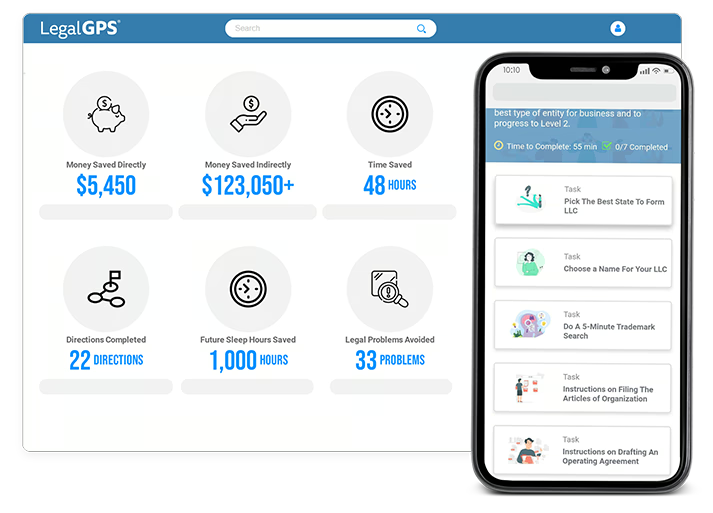
Legal GPS Pro
Protect your business with our complete legal subscription service, designed by top startup attorneys.
Recent industry data reveals that 78% of businesses using third-party APIs have never conducted a formal legal review of their licensing agreements. Even more alarming, API-related legal disputes have increased by 340% over the past three years, with average settlement costs exceeding $1.2 million per case.
The stakes couldn't be higher. A single overlooked clause in an API license can expose your business to copyright infringement claims, data privacy violations, or sudden service terminations that bring operations to a grinding halt. Understanding these risks isn't just about legal compliance—it's about protecting the foundation your business runs on.
API licensing governs how you can legally use someone else's programming interface to access their services, data, or functionality. Unlike traditional software licenses that you might encounter when purchasing business applications, API licenses often contain unique restrictions tied to usage volume, data handling, commercial purposes, and integration methods.
Most API providers offer multiple licensing tiers, from free developer accounts with strict limitations to enterprise licenses that cost hundreds of thousands annually. The licensing model directly impacts what you can legally do with the API, how you can store or manipulate the data you receive, and whether you can build commercial products using their service.
The complexity arises because API licensing sits at the intersection of copyright law, contract law, and increasingly, data protection regulations. When you integrate an API into your business processes, you're not just accessing a technical service—you're entering into a legally binding agreement that can have far-reaching implications for your entire operation.

API License Agreement for third-party access, usage terms, and integration guidelines.
Trusted by 1,000+ businesses to safeguard their LLCs.
The biggest misconception in API usage is equating "free" with "unrestricted." Free API tiers often come with the most stringent legal requirements, precisely because providers use these restrictions to drive users toward paid plans.
Free APIs typically include limitations on commercial use, strict attribution requirements, data retention restrictions, and clauses that allow providers to change terms or cut off access with minimal notice. Many entrepreneurs discover these limitations only after building their entire product around a free API service.
TechFlow Solutions built a project management dashboard that integrated heavily with Slack's free API to provide team communication analytics. After six months of development and beta testing, they launched their paid service to 200+ customers.
Three weeks later, Slack sent a cease-and-desist letter citing violations of their API terms, which prohibited using free API access to build competing commercial communication tools. TechFlow faced an immediate choice: shut down their service or pay Slack's enterprise API fees of $50,000 annually, plus a one-time licensing fee of $75,000 for past usage violations.
The startup was forced to choose between bankruptcy and selling to a larger competitor at a fraction of their projected valuation. The legal settlement ultimately cost them $125,000 and their independence as a company.
Rate limiting isn't just a technical constraint—it's a legal boundary. Exceeding API rate limits often constitutes a breach of contract, and automated systems that attempt to circumvent these limits can be classified as unauthorized access under computer fraud laws.
Many businesses implement workarounds like rotating API keys, using proxy servers, or creating multiple accounts to bypass rate limits. These seemingly innocent technical solutions can transform a simple contract dispute into federal criminal liability under laws like the Computer Fraud and Abuse Act.
Implement automated monitoring that tracks your API usage against contractual limits, not just technical limits. Set alerts at 70% and 90% of your contracted usage levels, and create escalation procedures that involve both technical and legal review before implementing any circumvention measures. Document all legitimate business needs that require higher usage limits as evidence for license upgrade negotiations.
API licenses increasingly include specific requirements about how you handle data received through their service. These requirements often extend beyond the API provider's own privacy policy to include restrictions on data storage, user consent, international transfers, and deletion procedures.
When you combine multiple APIs, you're often subject to the most restrictive privacy requirements among all your providers. A single API with GDPR requirements can impose compliance obligations on your entire data processing operation, even for data that never touches that specific service.
Marketing automation company GrowthHacker used Clearbit's API to enrich customer profiles with publicly available social media data. Their implementation seemed compliant—they only processed data for existing customers who had opted into their marketing communications.
However, Clearbit's API license required explicit GDPR consent for any data processing of EU residents, regardless of the original opt-in status. When a German customer filed a GDPR complaint, the investigation revealed that GrowthHacker had processed data for over 3,000 EU residents without proper consent documentation.
The resulting GDPR fine totaled $280,000, and GrowthHacker spent an additional $150,000 on legal fees and compliance system overhauls. More damaging was the six-month suspension of their EU operations while they implemented proper consent management systems.
API providers often require specific attribution, co-branding, or even competitive restrictions when you use their services in customer-facing applications. These requirements can conflict with your own branding strategy or create awkward user experiences that undermine your product positioning.
Attribution requirements can be particularly problematic for white-label solutions or products where revealing third-party dependencies might confuse customers or weaken your competitive position. Some API licenses even include clauses that allow the provider to require more prominent attribution as your usage grows.
Navigation app startup RouteGenius built their entire mobile application around Google Maps API, properly implementing the required attribution notices in their app's footer. After gaining 50,000 users, Google updated their API license to require attribution "prominently displayed" rather than just "clearly visible."
When RouteGenius refused to add a large "Powered by Google" banner to their main navigation screen, arguing it would confuse users about the app's ownership, Google terminated their API access. The startup had 72 hours to find an alternative mapping solution or face complete service shutdown.
The emergency migration to OpenStreetMap cost RouteGenius $180,000 in developer resources and resulted in a temporarily degraded user experience that caused them to lose 30% of their user base. The legal battle over what constituted "prominent" attribution lasted 18 months and cost an additional $220,000 in legal fees.
API licenses frequently change, and providers typically reserve the right to modify terms with as little as 30 days notice. Many businesses assume they'll be grandfathered under existing terms, but most API licenses specifically disclaim any grandfathering rights for pricing, usage restrictions, or compliance requirements.
The most dangerous scenario occurs when license changes make your existing business model incompatible with new API terms. Unlike traditional software licenses where you might continue using an existing version, APIs typically require ongoing connectivity, making it impossible to avoid new license terms by simply not upgrading.
Financial penalties from API licensing violations extend far beyond simple breach-of-contract damages. Companies face copyright infringement claims ranging from $750 to $150,000 per violation under federal law. For businesses processing personal data, GDPR fines can reach 4% of global annual revenue, while state privacy laws add additional penalty layers.
Operational disruption costs often exceed the direct legal penalties. When Spotify suddenly changed their API licensing terms in 2022, over 200 music discovery apps were forced to shut down permanently, representing an estimated $50 million in lost business value across affected companies.
Reputational damage proves equally costly. When customers lose trust due to service interruptions, data privacy violations, or forced feature removals, the impact on customer lifetime value can persist for years. Industry analysis shows that businesses experiencing API-related compliance failures see average customer churn rates increase by 35% in the following 12 months.
Begin with a complete inventory of every API your business uses, including development tools, analytics services, payment processors, and social media integrations. Document not just the technical implementation, but the specific license terms, usage levels, data flows, and compliance requirements for each service.
Many businesses discover they're using APIs they forgot about, often through third-party plugins, embedded widgets, or inherited code from contractors. These hidden API dependencies create unknown legal risks that can surface during customer audits, legal due diligence, or compliance investigations.
Create automated systems that track both technical usage metrics and contractual compliance indicators. Monitor API call volumes against license limits, data retention periods against policy requirements, and attribution compliance across all customer-facing implementations.
Establish clear escalation procedures that trigger legal review before usage approaches contractual limits or when technical teams propose new API integrations. Many compliance violations occur simply because technical teams implement solutions without understanding the legal implications of their architectural choices.
Require your development team to document the business justification, legal review status, and compliance monitoring plan for every API integration. This documentation becomes crucial during customer audits, legal disputes, or when evaluating whether to continue using services with changing license terms. Include specific contact information for each API provider's legal team, as having established relationships can dramatically reduce response times during compliance emergencies.
Implement mandatory legal review for any API that processes customer data, affects customer-facing features, or operates under non-standard licensing terms. Create standardized checklists that help your legal team quickly identify high-risk licensing provisions without becoming a bottleneck for legitimate development needs.
Consider establishing relationships with specialized technology lawyers who understand API licensing nuances. General business lawyers often miss the subtle but critical differences between traditional software licensing and API usage agreements, particularly around data processing, attribution requirements, and usage-based restrictions.
Social media management platform Buffer discovered during a routine compliance audit that they were violating Instagram's API license by storing user photos for longer than the permitted 24-hour period. Their backup systems were automatically retaining deleted social media content for 90 days to protect against accidental data loss.
Instead of trying to hide the violation, Buffer immediately contacted Instagram's legal team, documented the scope of the issue, and presented a detailed remediation plan. They temporarily suspended Instagram photo features, implemented automated deletion systems, and agreed to enhanced monitoring procedures.
Instagram appreciated the proactive approach and worked with Buffer to establish a custom enterprise license that accommodated their backup requirements for an additional $15,000 annually. Buffer's transparency and immediate response turned a potential $2 million lawsuit into a manageable compliance upgrade that actually strengthened their relationship with a critical platform partner.
Pay particular attention to API licenses with vague language around "competitive use," "fair use," or "reasonable limits." These subjective terms give providers broad discretion to terminate access based on their business priorities rather than your actual compliance status.
Be especially wary of clauses that allow providers to change pricing or usage limits without grandfathering existing customers. Some API providers use these clauses to effectively force acquisitions by making continued operation economically impossible for dependent businesses.
Rapid growth in API usage often triggers compliance issues even when you're technically within license limits. Many providers include clauses that allow them to renegotiate terms when usage patterns suggest you're building a business model they want to capture directly.
Monitor for changes in provider communication, such as direct outreach from business development teams, requests for detailed integration information, or suggestions about "partnership opportunities." These contacts often precede licensing enforcement actions or acquisition attempts.
Invest time in building direct relationships with API provider business development and legal teams before you need them. Many licensing disputes can be resolved quickly when you have established contacts who understand your business model and integration approach. Consider attending provider developer conferences, joining partner programs, or scheduling periodic check-ins to discuss your growing usage and future needs.
Essential contract provisions for API usage should include clear definitions of permitted use cases, explicit usage volume commitments, reasonable notice periods for license changes, and data portability requirements in case you need to migrate to alternative services.
Consider cyber liability insurance that specifically covers API-related risks, including business interruption from sudden service termination and regulatory penalties from compliance violations. Traditional business insurance often excludes technology-related risks, leaving significant gaps in your risk management strategy.
Legal GPS provides comprehensive contract templates and ongoing legal support specifically designed for technology businesses navigating complex API licensing landscapes. Our Pro subscription includes access to specialized attorneys who understand the unique challenges of building API-dependent businesses and can help you avoid the costly mistakes that derail promising companies.
The complexity of API licensing will only increase as data privacy regulations expand and providers become more sophisticated about monetizing their platforms. Investing in proper legal protection today isn't just about avoiding current risks—it's about ensuring your business can adapt and grow as the legal landscape continues to evolve around the technologies that power modern business operations.
Legal GPS Pro
Protect your business with our complete legal subscription service, designed by top startup attorneys.
|
Premium Template
Single-use Template |
Legal GPS Pro
Unlimited Access, Best Value |
|
|
| Choose Template | Learn More |
| Trusted by 1000+ businesses | |

Software-as-a-Service contracts have become the backbone of modern business operations. Yet a single overlooked clause can transform your helpful...

If you create and sell digital products, such as e-books, courses, software, or downloadable content, it's crucial to protect them with the right...

The e-commerce boom has created incredible opportunities for entrepreneurs to build thriving online businesses. However, beneath the surface of every...