

Smart Home Installation Gone Wrong: How to Avoid Tech Nightmares
Smart home technology promises convenience, security, and efficiency. But when installations go wrong, the legal and financial consequences can be...
8 min read
The electric vehicle revolution is transforming how Americans travel, and smart business owners are racing to install charging stations to capture this growing market. But beneath the surface of this green opportunity lurks a complex web of legal requirements that can turn a profitable investment into a financial nightmare.

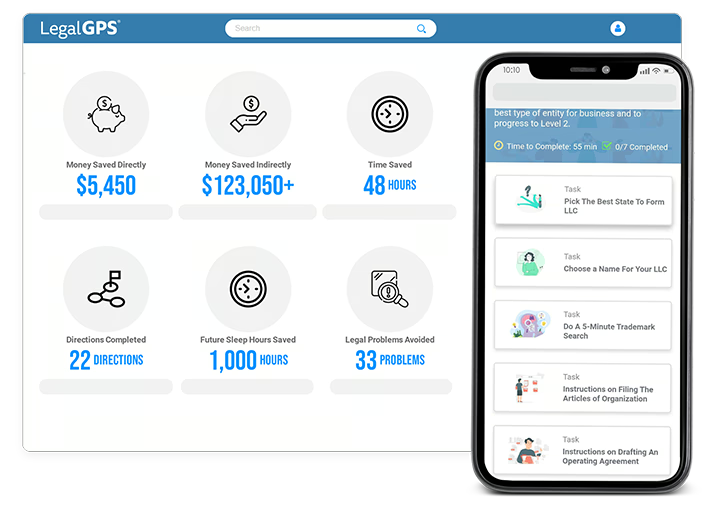
Legal GPS Pro
Protect your business with our complete legal subscription service, designed by top startup attorneys.
Recent industry data shows that over 60% of commercial EV charging installations face some form of legal complication, with average resolution costs exceeding $25,000. The entrepreneurs who succeed understand that proper legal preparation isn't just recommended—it's essential for protecting both their investment and their business future.
Installing EV charging stations involves navigating multiple layers of federal, state, and local regulations that many business owners don't discover until it's too late. Unlike simple electrical work, charging station installations trigger building codes, zoning requirements, ADA compliance rules, utility regulations, and liability considerations that can each carry significant financial penalties.
The complexity stems from the fact that EV charging stations are simultaneously electrical equipment, public accommodations, and utility interconnections. Each classification brings its own set of legal requirements, and missing any single element can result in costly delays, fines, or even forced removal of installed equipment.
Most business owners approach charging station installation thinking it's primarily a technical challenge. In reality, the legal preparation often determines whether the project succeeds or becomes a source of ongoing problems and expenses.

EV Charging Installation Contract covering scope, requirements, payments, and maintenance.
Trusted by 1,000+ businesses to safeguard their LLCs.
The permit process for EV charging stations extends far beyond basic electrical permits, and many business owners discover this after installation is already underway. Different municipalities classify charging stations differently—some treat them as electrical equipment, others as automotive service facilities, and still others as public utilities—with each classification requiring different permits and approvals.
Before any installation work begins, contact three separate offices: the local building department for construction permits, the zoning office for land use compliance, and the utility company for interconnection requirements. Request written confirmation of all requirements and timelines. This simple verification process typically costs under $500 but can prevent thousands in compliance problems.
Zoning compliance presents another common stumbling block. Many zoning codes written before the EV revolution don't explicitly address charging stations, leading to inconsistent interpretations and retroactive compliance issues. Commercial properties that seem perfect for charging stations may face zoning restrictions based on traffic flow, parking requirements, or use classifications.
The permit timeline can stretch from weeks to months, depending on local requirements and the complexity of the installation. Business owners who skip proper permit research often face stop-work orders that can delay projects for additional months while compliance issues are resolved.
Maria Rodriguez thought installing two Level 2 charging stations behind her popular Austin restaurant would be straightforward. She hired a licensed electrician and assumed he would handle all necessary permits. Six months after installation, the city issued a stop-use order after discovering the charging stations violated multiple zoning requirements.
The restaurant was located in a mixed-use district that required special use permits for "automotive service facilities," which the city classified the charging stations as. Additionally, the installation increased the property's required parking spaces under local code, but the restaurant didn't have space for additional parking.
Rodriguez faced $15,000 in city fines, $18,000 to relocate the charging stations to compliant locations, and $12,000 in legal fees to navigate the permit modification process. The charging stations remained unusable for eight months while she worked through the compliance issues, costing an estimated $8,000 in lost charging revenue.
EV charging stations must comply with National Electrical Code requirements as well as local electrical codes, which can vary significantly between jurisdictions. The high-power requirements of charging equipment create unique safety considerations that standard electrical work doesn't typically address, including ground fault protection, overcurrent protection, and proper ventilation for electrical equipment.
Many business owners hire general electricians without verifying their experience with EV charging installations. While these electricians may be fully licensed, they may not understand the specific code requirements for charging equipment, leading to installations that pass initial inspection but fail during later safety audits or after incidents occur.
The liability implications of electrical code violations are severe. Business owners can face personal liability for injuries or property damage resulting from improperly installed charging equipment, even when the work was performed by licensed contractors. Insurance companies regularly deny claims related to code violations, leaving business owners personally responsible for damages.
Kevin Park installed four Level 3 fast charging stations at his electronics retail store in Phoenix, hiring what he thought was a qualified electrical contractor. The contractor installed the equipment without proper ground fault protection, violating both local electrical code and manufacturer specifications.
Eight months later, a ground fault in one charging station caused an electrical fire that damaged two customer vehicles and part of the store building. The fire department investigation revealed the code violation, and Park's insurance company denied the claim based on the improper installation.
Park faced $95,000 in vehicle damage claims, $65,000 in building repairs, and $20,000 in legal fees defending against the customer lawsuits. He also had to pay an additional $15,000 to bring all charging stations into code compliance and install proper safety equipment.
The Americans with Disabilities Act applies to EV charging stations in ways that many business owners don't anticipate. Charging stations in public accommodations must meet specific accessibility requirements for spacing, reach ranges, operating controls, and clear floor space that go beyond standard parking accessibility requirements.
The ADA requires that a certain percentage of charging stations be accessible, with specific dimensional requirements that affect both the charging equipment and surrounding parking spaces. These requirements often conflict with property owners' desires to maximize the number of charging stations in available space.
Failure to meet ADA requirements can result in federal lawsuits with significant financial penalties, plus the cost of retrofitting installations to achieve compliance. ADA violations also expose business owners to ongoing monitoring and potential repeat violations if accessibility issues aren't properly addressed.
Mountain View Hotels installed charging stations at twelve of their properties across Colorado, focusing on maximizing the number of charging ports to serve more customers. The installations met electrical and building code requirements but didn't include proper ADA accessibility features.
A disability rights organization filed federal lawsuits against the hotel chain, claiming the charging stations violated ADA requirements for accessible parking and equipment operation. The charging stations had been installed too close together, didn't provide required clear floor space, and had control panels that exceeded ADA reach range requirements.
The company agreed to a $250,000 settlement that included $180,000 to retrofit all charging installations for ADA compliance, $45,000 in legal fees, and $25,000 in penalties to the disability rights organization. The retrofit work required removing and reinstalling multiple charging stations, disrupting hotel operations for several months.
Standard commercial insurance policies often don't adequately cover liabilities related to EV charging operations. Business owners need specialized coverage for electrical equipment, customer vehicle damage, cyber liability for connected charging systems, and professional liability for charging services.
The interconnected nature of modern charging systems creates cyber security risks that traditional property insurance doesn't address. Charging stations that connect to network management systems can become entry points for cyber attacks that compromise customer data or business operations.
Product liability represents another significant exposure. If charging equipment malfunctions and damages customer vehicles or causes injuries, business owners may face liability even when the equipment was properly installed and maintained. Manufacturer warranties often exclude certain types of damage, leaving business owners exposed to claims.
Work with an insurance agent experienced in EV charging operations to secure four specific coverages: enhanced electrical equipment coverage with full replacement value, commercial auto liability that covers customer vehicles while charging, cyber liability for network-connected systems, and umbrella coverage with at least $2 million limits. Document all safety procedures and maintenance records to support insurance claims.
Installation contracts for EV charging stations often contain clauses that shift liability and responsibility to property owners in ways that aren't immediately obvious. Many contracts limit the installer's liability to equipment replacement while excluding consequential damages, labor costs for reinstallation, or business interruption losses.
Payment terms in installation contracts can create cash flow problems when projects face delays or complications. Some contractors require large upfront payments before beginning work, leaving property owners with limited leverage if problems arise during installation or if the work doesn't meet specifications.
Require installation contracts to include completion dates with financial penalties for delays, comprehensive warranties covering both equipment and installation for at least two years, and liability coverage that includes consequential damages and business interruption. Limit upfront payments to 25% of total cost until work passes all required inspections.
Warranty terms vary dramatically between installation companies, and many business owners don't understand the difference between manufacturer warranties on equipment and installer warranties on labor and installation quality. Gaps between these warranties can leave business owners responsible for expensive repairs when problems develop.
Thompson Manufacturing contracted with a charging station installer to add Level 2 charging for their employee parking area. The contract included a clause limiting the installer's liability to equipment replacement value and required 70% payment before installation began.
The installer performed substandard electrical work that failed inspection twice, delaying the project by four months. When electrical problems developed after installation, the manufacturer's warranty excluded coverage because the installation didn't meet their specifications, and the installer's limited warranty only covered equipment replacement.
Thompson paid $35,000 upfront to the installer, then $25,000 to a second contractor to correct the electrical work, and $15,000 in additional electrical service upgrades required by the corrected installation. The delayed project also cost an estimated $8,000 in employee goodwill and recruiting advantages they had planned to gain from the charging stations.
Utility interconnection agreements for EV charging stations often include terms that grant the utility company ongoing rights to access, monitor, and potentially control the charging equipment. These agreements can affect property values and future development plans in ways that business owners don't anticipate when signing.
Electrical service upgrades required for charging stations may require easements or service agreements that restrict future property use. Some utility companies require dedicated transformers or electrical service that creates ongoing monthly costs regardless of actual charging station usage.
Multi-tenant properties face additional complications when tenants want to install charging stations but lease agreements don't clearly address electrical modifications, utility costs, or ongoing maintenance responsibilities. These situations can lead to disputes between property owners and tenants that disrupt business operations.
Sandra Kim owned a 48-unit apartment complex and wanted to install charging stations to attract tenants with electric vehicles. She signed a utility interconnection agreement without fully reviewing the terms, which granted the utility company perpetual access rights to the charging equipment and electrical service.
When Kim later wanted to sell the property, potential buyers' attorneys identified the utility agreement as creating an encumbrance that affected the property title. The utility company had rights that could potentially interfere with future development or redevelopment of the property.
Kim spent $20,000 in legal fees negotiating modifications to the utility agreement, $12,000 in title insurance issues related to the sale, and $3,000 in additional due diligence costs. The sale was delayed by three months while the utility issues were resolved, costing estimated carrying costs during the extended marketing period.
Smart business owners approach EV charging station installation as a legal project with technical components, rather than a technical project with legal requirements. Start by assembling a team that includes an attorney experienced with commercial real estate and utility regulations, an electrician with specific EV charging experience, and an insurance agent familiar with charging station risks.
Begin the legal preparation process at least 60 days before planned installation. This timeline allows sufficient time for permit research, utility coordination, contract negotiation, and insurance verification without rushing decisions that could create expensive problems later.
Document every step of the planning and installation process, including permit applications, inspection reports, contractor communications, and insurance confirmations. This documentation becomes essential if disputes arise or if you need to demonstrate compliance with regulations or contractual requirements.
Legal GPS Pro subscribers have access to comprehensive contract templates for EV charging installations, permit checklists for major metropolitan areas, and insurance verification worksheets that simplify the compliance process. Our charging station installation package includes contractor agreements, utility interconnection reviews, and ADA compliance verification tools designed specifically for business owners adding charging capabilities.
The electric vehicle market represents a tremendous opportunity for forward-thinking business owners, but success requires careful attention to the legal foundation supporting your investment. Take the time to build that foundation properly, and your charging stations will provide years of profitable service while avoiding the costly mistakes that trap unprepared entrepreneurs.
Don't let legal oversights turn your EV charging investment into a financial liability. Access Legal GPS Pro today for the templates, checklists, and guidance you need to install charging stations the right way from the start.
Legal GPS Pro
Protect your business with our complete legal subscription service, designed by top startup attorneys.
|
Premium Template
Single-use Template |
Legal GPS Pro
Unlimited Access, Best Value |
|
|
| Choose Template | Learn More |
| Trusted by 1000+ businesses | |

Smart home technology promises convenience, security, and efficiency. But when installations go wrong, the legal and financial consequences can be...

The solar industry is booming, but horror stories of botched installations and contractor disputes are multiplying just as fast. A poorly written...

Getting paid as a musician isn’t always as simple as playing a gig and collecting your money. Many bands struggle with late payments, last-minute...