

EV Charging Station Installation: How to Avoid Costly Mistakes
The electric vehicle revolution is transforming how Americans travel, and smart business owners are racing to install charging stations to capture...
9 min read
Smart home technology promises convenience, security, and efficiency. But when installations go wrong, the legal and financial consequences can be devastating. Without proper contracts and protections, what should be a modern upgrade can become an expensive nightmare that haunts your business or personal finances for years.

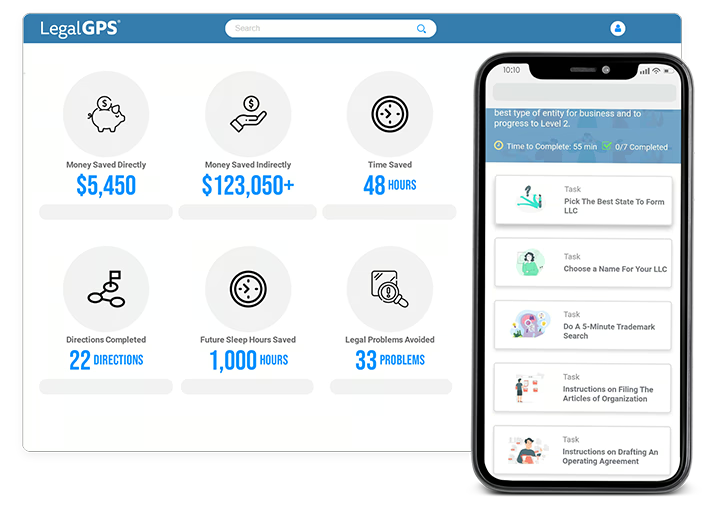
Legal GPS Pro
Protect your business with our complete legal subscription service, designed by top startup attorneys.
The smart home industry is booming, with installations projected to reach 537 million households globally by 2030. Yet most property owners rush into these projects without understanding the legal complexities involved. The result? Costly disputes, property damage, privacy breaches, and financial obligations that can cripple businesses and drain personal savings.
Smart home installations aren't simple purchases—they're complex technology integrations that touch property law, data privacy, and ongoing service relationships. Each connected device creates potential liability, and every installation involves multiple parties with different responsibilities and risk tolerance.
Modern smart home systems integrate dozens of components from various manufacturers, each with separate warranty terms, privacy policies, and support requirements. When something goes wrong, determining responsibility becomes a legal maze without clear contractual guidelines.
The financial stakes are higher than most people realize. Smart home installations can involve tens of thousands of dollars in equipment and labor costs. More importantly, failures can result in property damage, security breaches, and business disruption costs that dwarf the original investment.
Many entrepreneurs install smart technology in their business premises without considering how equipment failures might impact operations. A malfunctioning security system could compromise sensitive data, while heating and cooling failures might damage inventory or disrupt customer service.

Smart Home Installation Agreement covering scope, equipment, payments, and warranties.
Trusted by 1,000+ businesses to safeguard their LLCs.
Most smart home disasters stem from inadequate contracts that leave crucial questions unanswered. Who is responsible when a smart water sensor fails and floods your office? What happens if your security cameras are hacked and confidential business meetings are recorded? These scenarios require specific contractual protections that most standard installation agreements completely ignore.
Installation contracts often focus on equipment specifications while glossing over liability, warranty coverage, and long-term support obligations. This creates dangerous gaps when problems arise. Without clear responsibility allocation, property owners often find themselves bearing costs that should have been covered by installers or manufacturers.
Marcus Rodriguez learned this lesson the hard way when he hired TechSmart Installations to upgrade his law firm's offices with a comprehensive smart system. The contract seemed straightforward: $28,000 for smart thermostats, leak detection sensors, automated lighting, and security cameras throughout the three-story building.
The installation appeared successful until a smart water sensor in the server room malfunctioned during a weekend. Instead of alerting the monitoring service to a pipe leak, the sensor failed silently while water poured onto expensive servers and legal documents. By Monday morning, the damage totaled $85,000 in destroyed equipment and document recovery costs.
Marcus discovered that the installation contract contained no specific warranty for sensor reliability. TechSmart Installations pointed to the manufacturer's limited warranty, which excluded water damage caused by "sensor malfunction." The sensor manufacturer claimed improper installation voided their warranty. Marcus's business insurance denied coverage, arguing that the sensor system was supposed to prevent such damage.
The legal battle lasted eighteen months and cost Marcus an additional $47,000 in attorney fees before he finally recovered $60,000 in settlements. His law firm's reputation suffered when client documents were destroyed, leading to two malpractice claims. A proper installation contract with clear liability allocation and insurance requirements could have prevented this entire disaster.
Every smart home installation contract should include specific liability allocation clauses that clearly define who is responsible for different types of failures. Require your installer to maintain comprehensive liability insurance and provide proof of coverage before beginning work.
Include performance warranties that go beyond manufacturer specifications. Your contract should guarantee that the entire system will function as promised for a specific period, regardless of which individual component fails. This prevents finger-pointing between installers and manufacturers when problems arise.
Demand detailed documentation of all installation work, including photos of connections, configuration settings, and testing procedures. This documentation becomes crucial if you need to prove improper installation or make warranty claims later.
Smart home devices collect vast amounts of personal and business data, from daily schedules to security codes to video recordings of private spaces. Most users never read the privacy policies governing this data collection, creating serious risks for business owners who might inadvertently violate client confidentiality or employee privacy rights.
Many smart home devices automatically share data with third-party services for processing and storage. This data sharing often occurs without explicit notification, and the privacy policies governing this sharing can change at any time. For businesses handling sensitive information, these practices can create serious legal liability.
Sarah Chen installed smart security cameras throughout her marketing agency's offices, thinking they would improve security and help monitor productivity. The installation company, SecureVision Pro, recommended cameras with "advanced analytics" that could identify individuals and track movement patterns.
Three months later, Sarah discovered that the cameras had been automatically uploading footage to a third-party AI service for facial recognition processing. This data sharing wasn't clearly disclosed during installation, and Sarah hadn't realized that client meetings, employee conversations, and sensitive presentations were being recorded and analyzed by an unknown company.
When a major client discovered their strategic planning session had been recorded and processed by an AI service with unclear data retention policies, they terminated their $180,000 annual contract and threatened legal action for privacy violations. Two employees filed complaints with the state labor board, claiming the undisclosed surveillance violated their workplace privacy rights.
Sarah faced $65,000 in legal fees defending against privacy violation claims and lost $340,000 in client contracts when word spread about the unauthorized surveillance. The camera installation contract contained no mention of third-party data sharing, and SecureVision Pro claimed they weren't responsible for explaining manufacturer privacy policies.
Smart home warranties are often more complex and limited than traditional appliance warranties. Many components have different warranty periods, and some critical protections are voided by common installation practices. Without careful contract review, property owners often discover their warranty coverage is virtually worthless when they need it most.
Support contracts for smart home systems frequently exclude the most important services when problems arise. Many agreements cover only remote troubleshooting, leaving property owners without help for physical repairs or emergency service calls.
David Park invested $45,000 in a complete smart office system for his accounting firm, including automated lighting, climate control, security systems, and network infrastructure. The installation contract included a "comprehensive three-year warranty" that seemed to cover everything that could go wrong.
During tax season, a power surge damaged the central control hub that managed all smart systems. The office lighting failed, climate control stopped working, and security systems went offline. David discovered that the warranty only covered individual component replacement, not emergency service calls or temporary solutions during repairs.
The replacement hub required two weeks to arrive and another week for programming and testing. During the three-week outage, David had to rent emergency lighting and heating equipment while relocating critical operations to a temporary facility. The disruption cost his firm $89,000 in lost productivity, equipment rental, and temporary space costs.
The warranty contract specifically excluded "consequential damages" and provided no coverage for business interruption costs. David's business insurance contained a "technology failure" exclusion that applied to smart building systems. He ultimately recovered only $8,500 for the replacement hub while absorbing all other costs personally.
Never accept manufacturer warranties as your primary protection. Negotiate installation contracts that include comprehensive system warranties covering the entire installation, not just individual components. Require your installer to guarantee system functionality and provide emergency service commitments.
Include specific response time requirements in your service contract. For business installations, negotiate guaranteed response times for different severity levels, with financial penalties if service levels aren't met. This ensures you'll receive prompt attention when critical systems fail.
Document all system functionality before final acceptance. Test every feature and document baseline performance so you can prove when systems aren't performing as promised. This documentation becomes essential for warranty claims and insurance coverage.
Smart home systems create new categories of liability that traditional property insurance often doesn't cover. When connected devices cause property damage, security breaches, or personal injury, determining financial responsibility requires careful contract analysis and comprehensive insurance coverage.
Business owners face particular risks because smart system failures can disrupt operations, compromise customer data, and create safety hazards. Without proper liability allocation, these failures can result in significant financial exposure that threatens business survival.
Jennifer Walsh installed a smart access control system at her medical practice to improve security and track employee access. The system replaced traditional keys with smartphone-controlled locks and digital entry logs. The installation contract with Digital Access Solutions included standard warranty terms but no specific liability provisions for security failures.
Six months after installation, a software glitch caused all smart locks to fail during a weekend when the practice was closed. The malfunction left the building completely unsecured for fourteen hours before staff discovered the problem Monday morning. During this time, thieves accessed the building and stole computer equipment containing patient medical records for over 800 patients.
The data breach triggered federal HIPAA violation investigations and required expensive patient notification and credit monitoring services. Jennifer faced $125,000 in regulatory fines, $45,000 in breach notification costs, and $78,000 in credit monitoring services for affected patients. Her malpractice insurance denied coverage, arguing that the security breach resulted from "technology failure" rather than medical negligence.
Digital Access Solutions claimed their contract only covered lock hardware replacement, not security failures or consequential damages. The manufacturer's warranty specifically excluded liability for data breaches or security incidents. Jennifer's general liability insurance contained a "cyber security" exclusion that applied to technology-related breaches.
After two years of legal battles and regulatory proceedings, Jennifer recovered only $28,000 from various insurance policies and settlements. The remaining $195,000 came from her personal savings and practice revenues, forcing her to take on significant debt to keep the practice operating.
Successful smart home projects require extensive planning and legal preparation before any equipment is purchased or installed. The key is treating smart home installation as a complex technology project rather than a simple home improvement task.
Start by clearly defining your goals and requirements in writing. This documentation becomes the foundation for evaluating proposals and holding contractors accountable for delivering promised functionality. Without clear specifications, disputes over system performance become inevitable.
Research potential installers thoroughly, focusing on their insurance coverage, warranty policies, and customer complaint history. Check with state licensing boards and professional associations to verify credentials and identify any disciplinary actions or legal problems.
Avoid installers who won't provide proof of comprehensive liability insurance covering technology failures and property damage. Any legitimate contractor should carry at least $1 million in general liability coverage plus professional liability insurance for technology errors.
Be suspicious of contracts that limit warranty coverage to manufacturer terms only. Professional installers should stand behind their work with comprehensive system warranties that cover functionality regardless of which component fails.
Never accept contracts with broad limitation of liability clauses that exclude consequential damages or business interruption costs. These provisions leave you without recourse when installations fail and cause significant financial harm.
Smart home contracts often contain problematic terms that seem reasonable at first glance but create serious long-term obligations and risks. Learning to identify these red flags can save thousands of dollars and prevent years of legal problems.
Subscription-based service requirements are particularly dangerous when they're buried in installation contracts. Many smart home systems require ongoing monitoring or cloud services that create perpetual payment obligations with limited cancellation rights.
Tom Bradley thought he was getting a great deal when Smart Home Experts offered to install a $22,000 security and automation system with "no monthly fees." The contract mentioned "optional premium services" but focused primarily on equipment specifications and installation procedures.
After installation was complete, Tom discovered that basic system functions required an ongoing "cloud service subscription" at $185 per month. The subscription was technically "optional," but without it, the security system couldn't send alerts, the automation features didn't work, and the mobile app was non-functional.
The subscription contract included automatic annual renewals with a 30% price increase clause and required 90-day written notice for cancellation. When Tom tried to cancel after six months, he discovered that termination required payment of a "system deactivation fee" equal to 12 months of subscription costs.
Over five years, Tom paid $45,000 in subscription fees and penalties—more than double his original equipment investment. The contract's fine print made it nearly impossible to use the system without the subscription while making cancellation prohibitively expensive.
Tom's attorney found that the subscription requirements were deliberately obscured in the installation contract and likely constituted deceptive business practices. However, the arbitration clause in the contract made legal action expensive and time-consuming. Tom ultimately negotiated a $15,000 settlement but lost years of subscription payments.
Smart home technology offers genuine benefits when implemented with proper legal protections and realistic expectations. The key is approaching these projects as complex technology integrations that require careful planning, comprehensive contracts, and ongoing risk management.
Before starting any smart home project, consult with both technology and legal professionals to understand the risks and protection strategies. This upfront investment in professional advice typically saves significant money compared to dealing with problems after installation.
Consider starting with smaller, less critical installations to test contractors and understand how different systems integrate with your property and lifestyle. This gradual approach allows you to refine your contract requirements and protection strategies before committing to larger investments.
Legal GPS offers comprehensive contract templates and guidance specifically designed for technology installations and service agreements. Our Pro subscription includes access to smart home contract templates, warranty protection strategies, and liability allocation guidance that can prevent the costly mistakes outlined in this article.
Don't let your smart home dreams become legal nightmares. With proper planning and protection, you can enjoy the benefits of modern technology while avoiding the pitfalls that have trapped thousands of other property owners. The small investment in proper contracts and legal guidance pays enormous dividends in peace of mind and financial protection.
Take action today by reviewing any existing smart home contracts for the red flags discussed above, and ensure that future installations include comprehensive protections for your specific situation and risk tolerance.
Legal GPS Pro
Protect your business with our complete legal subscription service, designed by top startup attorneys.
|
Premium Template
Single-use Template |
Legal GPS Pro
Unlimited Access, Best Value |
|
|
| Choose Template | Learn More |
| Trusted by 1000+ businesses | |

The electric vehicle revolution is transforming how Americans travel, and smart business owners are racing to install charging stations to capture...

The solar industry is booming, but horror stories of botched installations and contractor disputes are multiplying just as fast. A poorly written...

In today's data-driven economy, analytics contracts are the backbone of countless business relationships. Whether you're hiring a consultant to...