

How to Buy Corporate Training That Actually Changes Employee Behavior
Companies spend over $366 billion annually on employee training, yet studies show that 70% of employees forget new information within 24 hours and...
8 min read
American companies spend over $366 billion annually on employee training programs, yet most business owners struggle to demonstrate meaningful return on investment. The frustration is real: expensive training initiatives that fail to improve performance, reduce turnover, or drive business growth.

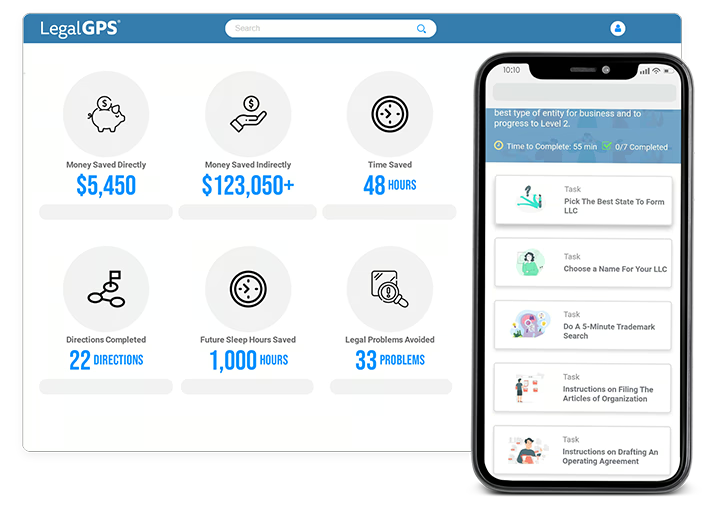
Legal GPS Pro
Protect your business with our complete legal subscription service, designed by top startup attorneys.
The problem isn't just poor curriculum design or disengaged employees. Many training program failures stem from fundamental legal and structural vulnerabilities that business owners never see coming. These gaps don't just waste money—they expose companies to significant liability while destroying any chance of measurable ROI.
From compliance documentation failures to vendor contract weaknesses, the legal foundation of your training program directly impacts its success. When these elements aren't properly addressed, even the most well-intentioned training investments become costly mistakes that hurt both employee development and business protection.
Most business owners approach employee training as an educational initiative without considering the legal documentation requirements that make it effective. Federal and state regulations require specific types of training for different industries, and failure to properly document these programs can result in penalties that dwarf your training investment.
OSHA alone requires documented training for over 100 different workplace scenarios. The Department of Labor mandates specific training records for wage and hour compliance. Industry regulators like FDA, FINRA, and state licensing boards each have unique documentation standards that must be met.
When training programs lack proper legal structure, companies lose the protection these programs are designed to provide. More critically, they can't demonstrate compliance during audits or investigations, turning what should be a defensive asset into a liability.

Corporate Training Agreement for learning objectives, delivery methods, and IP rights.
Trusted by 1,000+ businesses to safeguard their LLCs.
Healthcare, manufacturing, financial services, and food service industries face particularly complex training compliance requirements. Each sector has specific legal obligations that, when missed, can trigger investigations and penalties that eliminate any training ROI.
The challenge is that generic training programs often miss industry-specific legal requirements. A manufacturing company implementing leadership training without addressing OSHA safety training obligations creates a gap that regulators will eventually discover. Financial services firms focusing on sales training while ignoring FINRA continuing education requirements face similar risks.
MedTech Solutions, a 200-employee medical device manufacturer in Ohio, invested $400,000 in a comprehensive employee development program in 2023. The program included leadership training, technical skills development, and team building initiatives that employees loved.
When OSHA conducted a routine inspection eight months later, they discovered that MedTech's focus on general employee development had led them to overlook mandatory safety training requirements for equipment operators. Despite spending substantial money on employee training, the company couldn't demonstrate compliance with required safety protocols.
The result: $2.3 million in OSHA penalties, a six-month production shutdown, and mandatory remediation training that cost an additional $180,000. MedTech's well-intentioned training investment became a liability because it wasn't structured to meet legal compliance requirements first.
Training program contracts with external vendors often contain gaps that expose businesses to significant financial and legal risk. Most business owners focus on curriculum content and pricing while overlooking critical protection clauses that determine whether their training investment delivers value.
Common contract deficiencies include unclear intellectual property ownership, inadequate performance guarantees, weak confidentiality protections, and missing indemnification clauses. These gaps can result in disputes that consume more resources than the original training investment.
When vendor relationships fail without proper contract protection, companies lose both their training investment and the time spent implementing failed programs. Even worse, poorly structured contracts can expose proprietary business information or create liability for vendor misconduct.
The agreements between companies and employees regarding training participation, completion requirements, and continued employment obligations are often poorly structured or missing entirely. This creates enforcement challenges that undermine training program effectiveness and ROI.
Without clear contractual frameworks, companies struggle to ensure training completion, measure performance improvements, or recover training investments when employees leave shortly after expensive training programs. Employment law requirements around training reimbursement, performance expectations, and termination procedures must be properly addressed to protect training investments.
Every training program should include three critical contract elements: completion requirements with specific deadlines, performance measurement criteria with defined outcomes, and cost recovery provisions that protect your investment if employees leave within 12-24 months of training completion.
Include vendor indemnification clauses that protect against third-party claims arising from training content or methods. Establish clear intellectual property ownership for any materials developed during training programs. Create confidentiality protections that prevent sensitive business information from being shared during external training programs.
Document these requirements in both vendor agreements and employee training contracts to ensure comprehensive protection. Consider requiring signed acknowledgments for each training session to demonstrate participation and understanding.
Training programs often involve the creation or sharing of valuable intellectual property, from proprietary processes to customer lists to strategic information. When IP ownership isn't clearly established, companies can lose control of valuable assets developed during training initiatives.
External training vendors may claim ownership rights to customized content created for your company. Internal training materials developed by employees may not be properly protected as company property. Guest speakers or consultants might retain rights to methodologies or processes shared during training sessions.
These IP disputes can result in expensive litigation and the loss of competitive advantages that training programs were designed to create. More significantly, they can expose companies to claims when former employees or vendors use proprietary information in competing businesses.
Training programs that involve sharing sensitive business information without proper protection measures can result in the loss of trade secret status for valuable company assets. Once information is disclosed without appropriate safeguards, it may no longer qualify for trade secret protection.
Employee training sessions, vendor collaborations, and external training events all present opportunities for inadvertent disclosure of proprietary information. Without proper legal frameworks, these educational initiatives can compromise the very assets they're designed to develop and protect.
DataCorp, a data analytics company in Texas, hired an external consultant to provide advanced data modeling training for their 45-person technical team in 2022. The training program cost $120,000 and was designed to improve the team's ability to develop proprietary algorithms for client projects.
The consultant's agreement lacked clear intellectual property clauses regarding content developed during the training process. When DataCorp's team created several breakthrough algorithms during collaborative training sessions, both DataCorp and the consultant claimed ownership rights to the innovations.
The resulting lawsuit lasted 18 months and cost DataCorp $1.8 million in legal fees and settlements. The consultant was awarded partial rights to algorithms that DataCorp had planned to use as competitive advantages. DataCorp's training investment not only failed to deliver ROI—it created a competitor who now licenses similar technology to DataCorp's clients.
Training programs fail to deliver measurable ROI when companies lack proper systems for documenting participation, tracking progress, and measuring outcomes. Legal requirements for training records vary by industry, but most business owners don't understand the documentation standards needed to protect their investment.
Employment law requires specific types of training documentation to defend against discrimination claims, wage and hour disputes, and wrongful termination lawsuits. Regulatory compliance training must be documented to meet industry standards and government oversight requirements.
When training records are inadequate, companies can't demonstrate the value of their investment to stakeholders or use training completion as a factor in employment decisions. Poor documentation also eliminates the legal protection that proper training programs provide in disputes and investigations.
RestaurantChain, a 12-location restaurant group in Florida, invested $250,000 in management training programs focused on leadership development, customer service, and operational efficiency throughout 2023. The programs were well-received by managers and appeared to improve restaurant performance.
When three former managers filed discrimination lawsuits claiming they were passed over for promotion due to protected characteristics, RestaurantChain attempted to defend their promotion decisions based on training program participation and performance. However, their documentation system couldn't demonstrate which managers completed specific training modules, their performance during training, or how training outcomes factored into promotion decisions.
Without adequate training records, RestaurantChain couldn't use their substantial training investment to defend against the discrimination claims. They settled all three cases for a total of $950,000 rather than face trial without proper documentation. Their training program actually became a liability when lawyers argued that inconsistent training access contributed to discriminatory promotion practices.
Many training programs fail because companies can't demonstrate ongoing compliance with legal requirements. Initial training completion isn't sufficient—most regulations require refresher training, updated certifications, and continuous education to maintain compliance status.
Without proper tracking systems, companies lose visibility into which employees need additional training, when certifications expire, and whether their workforce maintains required competency levels. These gaps create liability exposure that eliminates any protective value from training investments.
Training program success depends on contract structures that align vendor interests with your business outcomes. Include specific deliverables, timelines, and performance metrics in all training agreements. Establish clear remedies for vendor failures and protection against IP disputes.
Employee participation agreements should establish training as a condition of continued employment when appropriate, with clear consequences for non-completion. Include cost recovery provisions that protect substantial training investments while complying with employment law requirements.
Create tiered contract structures that provide different levels of protection based on training investment size and strategic importance. High-value training programs require more comprehensive legal protection than basic compliance training.
Structure your training program with three foundational legal elements: comprehensive vendor agreements that include performance guarantees and IP protections, employee training contracts that establish completion requirements and cost recovery provisions, and documentation systems that meet both regulatory compliance and employment law standards.
Establish specific ROI measurement criteria in all training contracts, including productivity metrics, retention targets, and compliance outcomes. Create legal frameworks that allow you to enforce training requirements and recover investments when employees don't meet obligations or leave prematurely.
Document the business justification for each training program to demonstrate that investments serve legitimate business purposes rather than arbitrary employee benefits. This documentation protects against discrimination claims while establishing the foundation for ROI measurement.
Implement documentation systems that serve multiple purposes: regulatory compliance, employment law protection, and ROI measurement. Training records should include participation tracking, competency assessment, performance improvement measurement, and business impact analysis.
Establish retention periods for training documentation that exceed legal requirements to ensure records are available for future disputes or audits. Create standardized reporting formats that demonstrate training program value to stakeholders and support budget justification for future investments.
Design documentation workflows that capture training outcomes in real-time rather than relying on post-program surveys or assessments. This approach provides stronger legal protection and more accurate ROI measurement.
Training programs represent significant investments in employee development that companies must protect when key personnel leave. Without proper legal frameworks, departing employees can take training benefits to competitors while leaving companies without the expected ROI.
Employment agreements should address training investments in compensation discussions, non-compete considerations, and severance negotiations. Companies need clear policies about training cost recovery when employees leave within specific timeframes after completing expensive programs.
TechStartup, a 75-employee software company in California, signed a $150,000 contract with a training vendor to provide cybersecurity certification for their entire technical team in early 2024. The program was scheduled to complete over six months with specific certification outcomes guaranteed.
The training vendor's contract included a broad force majeure clause and weak performance standards. When the vendor's key instructor left the company three months into the program, they invoked the force majeure clause and claimed they couldn't complete the training as originally designed.
TechStartup's legal review revealed that their contract lacked specific remedies for vendor performance failures and didn't include adequate protection against key personnel changes. The resulting dispute required $500K in legal fees and consulting costs to resolve, plus additional expenses to complete the training with a different vendor. TechStartup's training investment tripled due to inadequate contract protection.
Consider structuring high-value training programs with retention bonuses, extended employment commitments, or graduated cost recovery provisions that protect training investments while remaining enforceable under employment law.
Conduct quarterly legal audits of your training programs using this framework: verify that all vendor contracts include IP protection and performance guarantees, confirm that employee agreements establish clear training obligations and cost recovery rights, and ensure that documentation systems meet both regulatory and legal defense requirements.
Review training program compliance with industry-specific regulations and employment law requirements. Assess whether training investments are properly structured to serve as legal defenses against discrimination, safety, or competency claims.
Analyze training cost recovery provisions to ensure they're enforceable and aligned with business protection goals. Consider whether training programs create competitive advantages that require additional IP protection or non-disclosure agreements.
Employee training programs fail to deliver ROI when they lack proper legal foundation and protection. The most expensive mistake business owners make is treating training as purely an educational initiative while ignoring the legal and contractual structure needed for success.
Successful training programs require comprehensive vendor agreements, clear employee obligations, proper documentation systems, and IP protection measures. When these elements are properly structured, training investments deliver measurable returns while providing legal protection against employment disputes and regulatory investigations.
The Legal GPS Pro subscription provides access to training contract templates, compliance tracking tools, and employment agreement frameworks designed specifically for training program protection. Our templates help business owners structure training investments with proper legal safeguards from the beginning.
Don't let another training program fail due to preventable legal gaps. Legal GPS templates and expert guidance help you protect training investments while maximizing their business value. Start with proper legal foundation, and your training programs will deliver both employee development and business protection that justify their cost.
Legal GPS Pro
Protect your business with our complete legal subscription service, designed by top startup attorneys.
|
Premium Template
Single-use Template |
Legal GPS Pro
Unlimited Access, Best Value |
|
|
| Choose Template | Learn More |
| Trusted by 1000+ businesses | |

Companies spend over $366 billion annually on employee training, yet studies show that 70% of employees forget new information within 24 hours and...

The fitness industry faces an unprecedented surge in legal challenges, with lawsuits against personal trainers, gyms, and fitness facilities...

Your mission-critical software just crashed. Customer orders are backing up. Your team is panicking. You confidently reach for that expensive support...